
ARTICLES / BLOG
The Tax on Waiting

As the year draws to a close, businesses and financially conscious individuals alike begin reviewing their financial priorities. For businesses, carefully timing revenues and expenses can make a meaningful difference. For individuals, optimizing the taxation of investment returns can offer equally significant benefits.
Many types of interest income earned by individuals in Hungary are currently subject to 15% personal income tax and a 13% social contribution tax (szocho). Together, these amount to a 28% tax burden, leaving investors with just HUF 72 of every HUF 100 in taxable interest. However, not all investment income is taxed equally. Gains from controlled capital market transactions, for example, are generally subject to 15% personal income tax without the additional social contribution tax.
One of the best-known ways to earn interest tax-free is to invest in Hungarian government securities issued on or after June 1, 2019. Subject to the applicable conditions, these securities offer interest income free from both personal income tax and social contribution tax for individual investors. For other investments, time itself can provide an opportunity to reduce the tax burden.
One such arrangement is the Hungarian Long-Term Investment Account (Tartós Befektetési Számla, or TBSZ). Rather than being an investment product in its own right, a TBSZ is a special tax-advantaged account structure. Banks and investment service providers offer deposit-based and securities-based versions. With any one provider, an investor may open one account of each permitted type per calendar year.
A key feature of the TBSZ is the collection year, the calendar year in which the account is opened and funds can be deposited. From January 1 of the following year, no additional funds may be contributed. Within a securities-based TBSZ, however, existing investments can still be reallocated and returns reinvested.
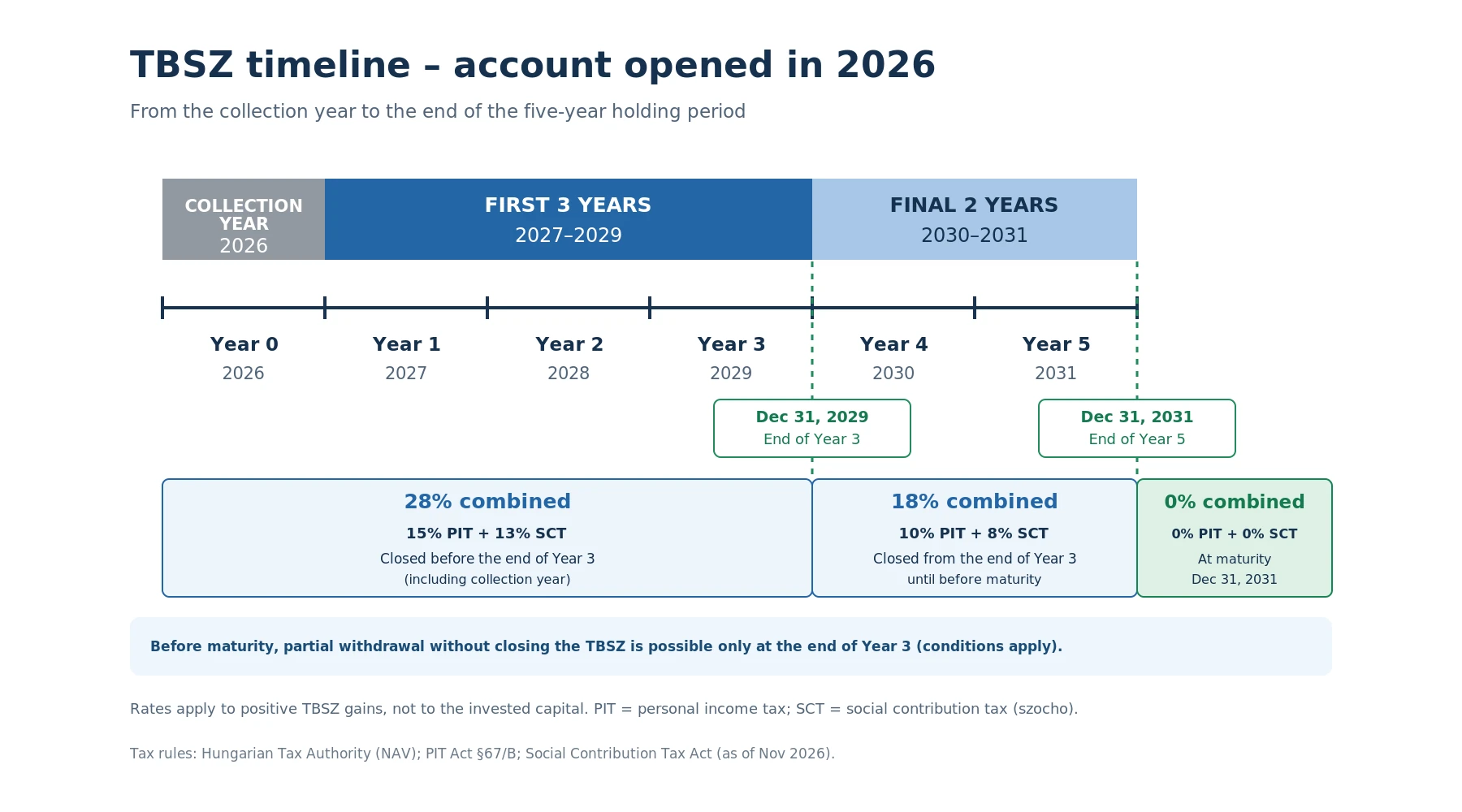
For a TBSZ opened in 2026, the collection year ends on December 31. The five-year holding period begins on January 1, 2027 and ends on December 31, 2031. Investors who open an account only in 2027 will reach full tax exemption a year later.
If a TBSZ opened in 2026 is terminated before the end of its third holding year, any positive gain within the account is subject to a combined 28% tax burden (15% personal income tax and 13% social contribution tax). At the three-year milestone on December 31, 2029, a partial withdrawal may be made under the applicable rules, with the withdrawn portion's positive gain subject to an 18% combined tax rate (10% personal income tax and 8% social contribution tax). The same rate applies if the account is terminated at this milestone or subsequently before its five-year maturity. At the end of the fifth year, positive gains become fully tax-exempt. Early termination of a TBSZ may therefore result in a different tax burden from holding the same investment in a regular securities account.
I often explain how this works with a piggy bank. Imagine placing your savings into a special piggy bank that you can fill until midnight on New Year's Eve in the year you open the account. After that, the slot at the top closes, but the investments inside can continue generating returns.
If you need access to your money before the three-year milestone, you must break open the piggy bank. At the end of the third year, however, you can pop out a small rubber stopper on its underside and withdraw part of your savings without breaking the entire bank. Positive gains attributable to the amount withdrawn may be subject to 18% tax, while the remaining funds can continue towards full tax exemption after five years. Before the five-year maturity date, this partial withdrawal option is available only at the three-year milestone and may require advance instructions to the account provider.
To illustrate the potential tax savings, consider an initial investment of HUF 10 million earning an assumed annual return of 9% after investment costs but before taxes. Over five years, the investment could grow to approximately HUF 15,386,240, generating a gain of HUF 5,386,240.
If the entire gain were classified as interest income subject to the 28% tax burden in a regular account, with tax becoming payable only at the end of the period, the resulting tax liability would be HUF 1,508,147. In a TBSZ maintained until the end of its five-year holding period, the positive gain could instead become fully tax-exempt. In this example, the TBSZ saves more than HUF 1.5 million in tax.
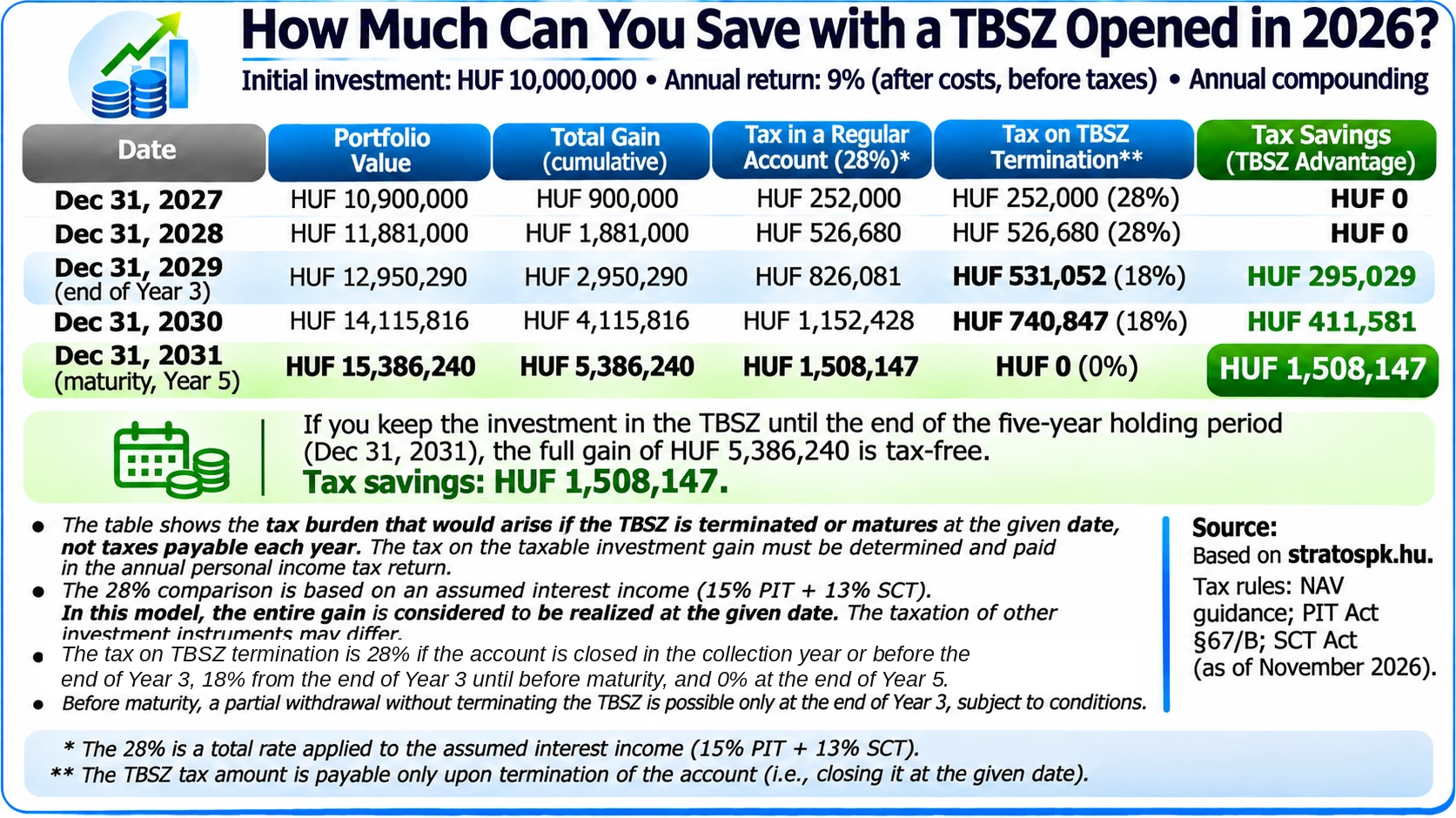
This calculation is for illustrative purposes only and the assumed return is not guaranteed. The model assumes annual compounding over the five years from 2027 to 2031 and excludes any potential return during the 2026 collection year. Actual tax savings depend on the investment type and the applicable tax rules.
A TBSZ is not necessarily the best solution for every investment. For example, holding otherwise tax-exempt Hungarian government securities within a TBSZ may create a tax liability if the account is terminated early.
Investor protection is supported by the obligation of investment service providers to segregate client assets, the Magyar Nemzeti Bank's (MNB) ÉSZLA service for checking securities account balances and, under specified conditions, the Investor Protection Fund (BEVA). BEVA compensation is capped at the equivalent of EUR 100,000 per investor per member institution. Compensation covers 100% of the first HUF 1 million and 90% of the amount above that threshold, subject to the overall cap. These safeguards do not protect investors against market losses.
At the end of the five-year period, a TBSZ can be renewed, allowing investors to continue investing returns that have already become tax-exempt. For an account opened in 2026, a new holding period may begin on January 1, 2032.
Above all, a savings or investment arrangement must suit our financial goals. Let's not put the cart before the horse! It makes sense to keep an emergency reserve for short-term needs separate from longer-term investments, so that an unexpected expense does not force us to close a TBSZ early.
The end of the year is not only a time to review past financial results but also an opportunity to plan our future more deliberately. Anyone wishing to take advantage of the 2026 collection year must open their TBSZ and fund it by December 31.
Because in the world of investing, what matters is not only how much we earn, but how much of it we ultimately get to keep.
Would you like to review your own financial situation and goals as a whole?
During the initial needs-assessment consultation, we review your current situation and possible next steps.