
ARTICLES / BLOG
The Price of Time

When making financial decisions, we tend to overlook one of the most important factors: time. Yet time is a resource that each of us has only a limited amount of. We can grow our money, but we cannot recover time that has been lost. One of the fundamental tasks of sound financial planning is therefore to align the time we have available to achieve our goals with the characteristics of different financial instruments.
When choosing financial instruments, there are three key factors to consider: safety, return and liquidity, meaning how easily we can access our money. These three factors are commonly referred to as the investment triangle. In practice, no financial solution can offer exceptionally high returns, complete safety and immediate access to our money all at once. We therefore have to make compromises between these benefits. The most important question is not necessarily which investment generates the highest return, but when we will need our money, how much risk we can afford to take and what we want to achieve.
In financial planning, we can distinguish between three basic time horizons: short, medium and long term. In the short term, meaning within one year, our primary objective is to cover our everyday expenses securely and deal with unexpected costs. What happens if our car or refrigerator breaks down, or if we temporarily lose our income? Do we have savings that we can access quickly?
A common rule of thumb in financial practice is to build an emergency fund that covers three to six months of living expenses. Over this time horizon, safety and liquidity take priority within the investment triangle, even at the expense of higher returns. Possible solutions include money held in a bank account, an easily accessible bank deposit, a money market fund or a short-term government security. However, these instruments differ in their risks and accessibility, so their specific terms and conditions must also be considered. It is equally important not to build an excessively large emergency fund, as keeping money in low-yielding instruments for too long may come at a cost through forgone returns and the loss of purchasing power caused by inflation.
If, for short-term speculative purposes, we choose high-risk instruments such as shares or leveraged transactions, we must sacrifice some safety in exchange for the possibility of higher returns. Short-term price movements can lead to substantial gains, but also significant losses. Leverage increases the risk further and, in certain transactions, losses may even exceed the amount originally invested.
In the medium term, typically over a period of three to seven years, we are generally planning to finance larger expenses that can be anticipated in advance. These might include renovating our home, replacing a car or taking a significant family holiday. Over this period, we may have opportunities to use financial instruments offering higher returns, although the timing of our goal remains a determining factor.
The most important characteristic of medium-term planning is establishing a balance between safety, return and liquidity. The closer we get to the point when we need to use our money, the greater the emphasis we should place on preserving capital and ensuring access to it. For more distant goals, we may have greater scope to accept moderate investment risk. Suitable instruments for these purposes may include government securities with different maturities, bonds, bond funds, mixed-asset and absolute-return investment funds and, under appropriate circumstances, solutions that also include equity exposure. Over this time horizon, we typically make tactical decisions in which we must consider potential losses and accessibility alongside expected returns.
In the long term, which in my own approach means a period of more than ten years, we prepare for the major financial goals of our lives. Supporting our children's education and their start in adult life, purchasing property in the future or financing our living expenses in retirement are all goals worth preparing for well in advance. Over this time horizon, the potential for higher returns may take on greater importance, while the need for immediate access to our money may become less significant.
A longer time horizon allows us to spread our savings across different instruments and makes it easier to withstand short-term market fluctuations. Equities, equity funds, property investments, longer-maturity bonds and other instruments exposed to market price risk may play a greater role. However, a longer investment horizon does not in itself guarantee either capital preservation or a positive return. Appropriate investment selection and risk diversification therefore remain essential.
One of the most important relationships in long-term financial planning can be illustrated by a simple idea: Capital = Money × Time. This is not a literal financial calculation formula, but rather an expression of the fact that time, alongside the money available to us, plays a decisive role in building capital. The earlier we start saving, the longer our money can work for us and the greater the potential impact of compound interest.
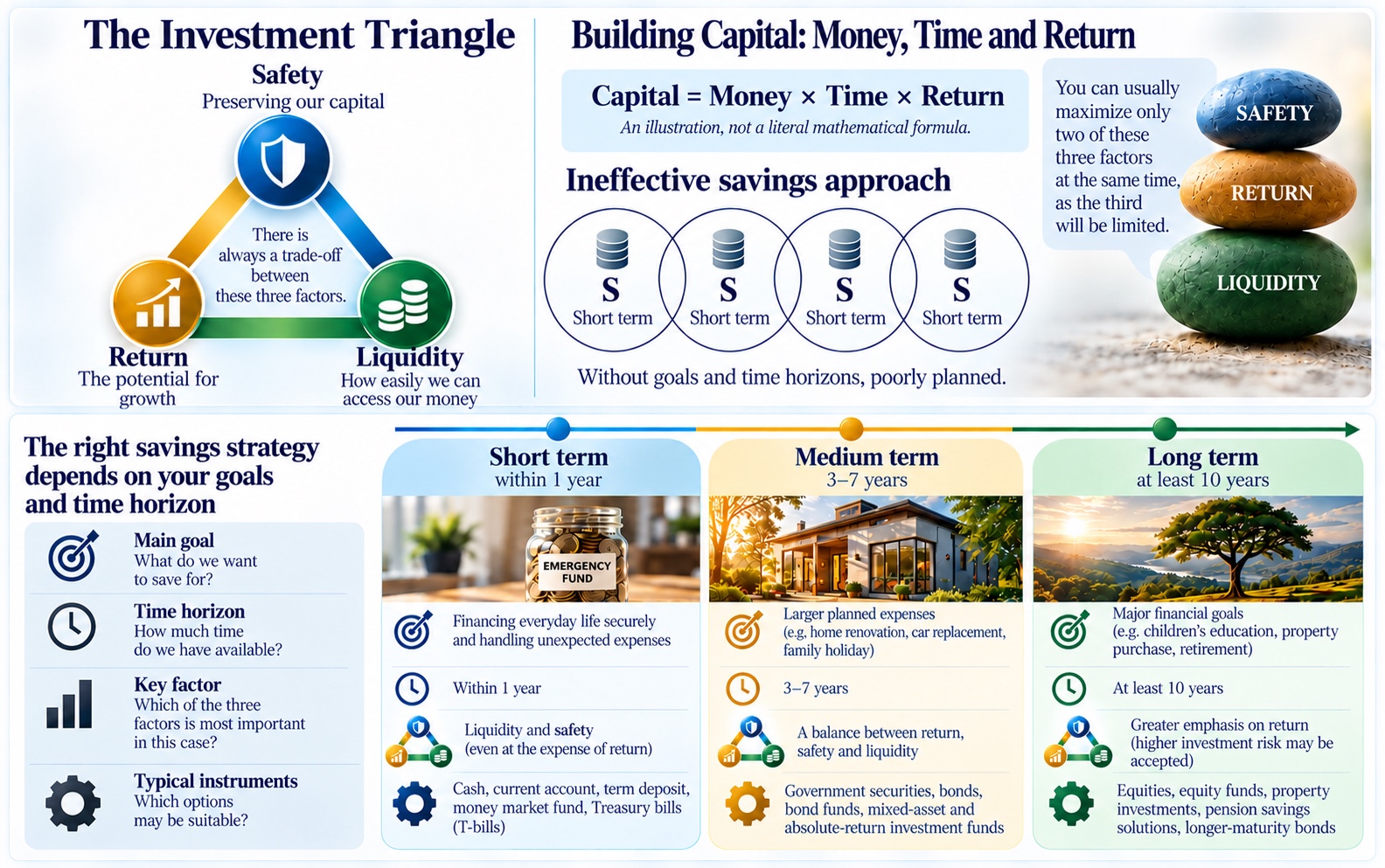
Consider retirement savings. Someone who starts setting money aside regularly in their twenties has several decades to build the capital they need. Someone who begins doing the same in their fifties will generally need to save a substantially higher amount each month to achieve the same goal. The difference is caused not only by the money contributed, but also by the combined effect of time and the returns that may be earned along the way. The fable of the ant and the grasshopper illustrates this well: the ant planned ahead and prepared for winter, while the grasshopper lived for the present. Financial awareness, however, does not mean giving up the pleasures of today. Rather, it means finding a balance between our current quality of life and our future financial security.
One of the costs of using money is interest. When we save or invest, we have the opportunity to earn interest or investment returns. When we take out a loan, however, we generally pay interest for the ability to use future income today. Borrowing is not necessarily a bad decision in itself, but poorly planned expenses and excessive debt can significantly restrict our financial flexibility over the long term.
Procrastination also comes at a price. If we begin saving for a long-term goal several years later, we lose not only the amounts we could have set aside earlier, but also the returns those amounts might have generated in the meantime. Time that has been lost can often be partially compensated for later only through a substantially greater financial commitment.
The essence of sound financial planning is to manage our short-term security, medium-term plans and long-term goals in harmony with one another. Time continues to pass and circumstances change, but the decisions we make today can influence our future. Money can be replenished, but time cannot.
Would you like to review your own financial situation and goals as a whole?
During the initial needs-assessment consultation, we review your current situation and possible next steps.